Professional movers reveal their best-kept packing secrets. Pack smarter, faster, and protect your belongings.
The average person underestimates packing time by 3x. A 2-bedroom apartment that looks manageable on a Tuesday will take you the entire weekend if you go in without a system. Our crew has loaded and unloaded thousands of moves, and the difference between a 2-hour job and a 4-hour job usually comes down to one thing: how the boxes are packed. Here is what the fastest, most efficient packers do differently.
- Roll clothes, do not fold them
- Use socks to protect glasses and mugs
- Label all 4 sides and the top
- Heavy items in small boxes, light items in large boxes
- Photograph your electronics setup before unplugging
- Pack an open-first box and put it in your car
- Use towels and linens as packing material
- Never leave empty space in boxes
- Tape the bottom in an H-pattern
- Pack plates vertically like records
How to pack efficiently: the core principles
Efficient packing comes down to three rules: every box should be liftable by one person (under 35 lbs), every box should be full so it does not collapse in the truck, and every box should be labeled on all visible sides. If you follow those three rules, you are already ahead of 80% of people who move every year.
Roll clothes, do not fold them
Rolling removes air pockets and reduces volume by 30-40%. It also means fewer wrinkles than folding flat. Start at the collar, roll tight, and stand the rolls upright in a box like cylinders in a tube. You will fit significantly more into a medium box this way.
Use socks to protect glasses and mugs
A clean sock over a glass provides as much cushioning as bubble wrap. It also eliminates waste since you are packing the socks anyway. For mugs, stuff the inside of the mug with a rolled washcloth or small kitchen towel, then wrap the outside with a second sock. Zero extra materials needed.
Heavy items in small boxes, light items in large boxes
Books, tools, dishes, and canned food go in small boxes. Pillows, linens, lampshades, and stuffed animals go in large boxes. The rule: every box should be liftable by one person without straining. That is 30-35 lbs maximum. A large box full of books will hit 60+ lbs and someone will get hurt or the bottom will give out.
From the field
The box that causes the most problems is never labeled "fragile." It is the oversized box someone packed with books, dishes, and whatever else was nearby. It weighs 70 lbs, the bottom splits on the stairs, and suddenly we are on the floor picking up dishes. Pack by weight, not by room., Undergrads crew, Charlotte
Get my free quote →Packing supplies: what you actually need vs. what you can skip
Most people overbuy packing supplies. Here is the honest breakdown of what matters and what is a waste of money.
| Supply | Need It? | Better Alternative |
|---|---|---|
| Bubble wrap | Sometimes | Towels, t-shirts, socks for most items |
| Packing paper | Yes, one bundle | Crumpled newspaper also works for non-fragile items |
| Moving boxes | Yes, sized correctly | Liquor store boxes are free and very sturdy |
| Box tape gun | Yes, worth the $8 | Tape without a gun is slow and frustrating |
| Wardrobe boxes | Only for suits/dresses | Roll everything else |
| Packing peanuts | No | Crumpled paper fills gaps just as well |
| Specialty dish boxes | Nice but optional | Vertical packing in standard boxes works |
Where to get free boxes
- Liquor stores: thick double-walled boxes, often free if you ask before 10am
- Nextdoor and Facebook Marketplace: people give away boxes after every move
- Whole Foods and Trader Joe's: produce boxes are clean and strong
- Book stores: great for heavy items, already sized for books
- Your office: breakroom supply boxes are usually headed for recycling
The labeling system that actually works on move day
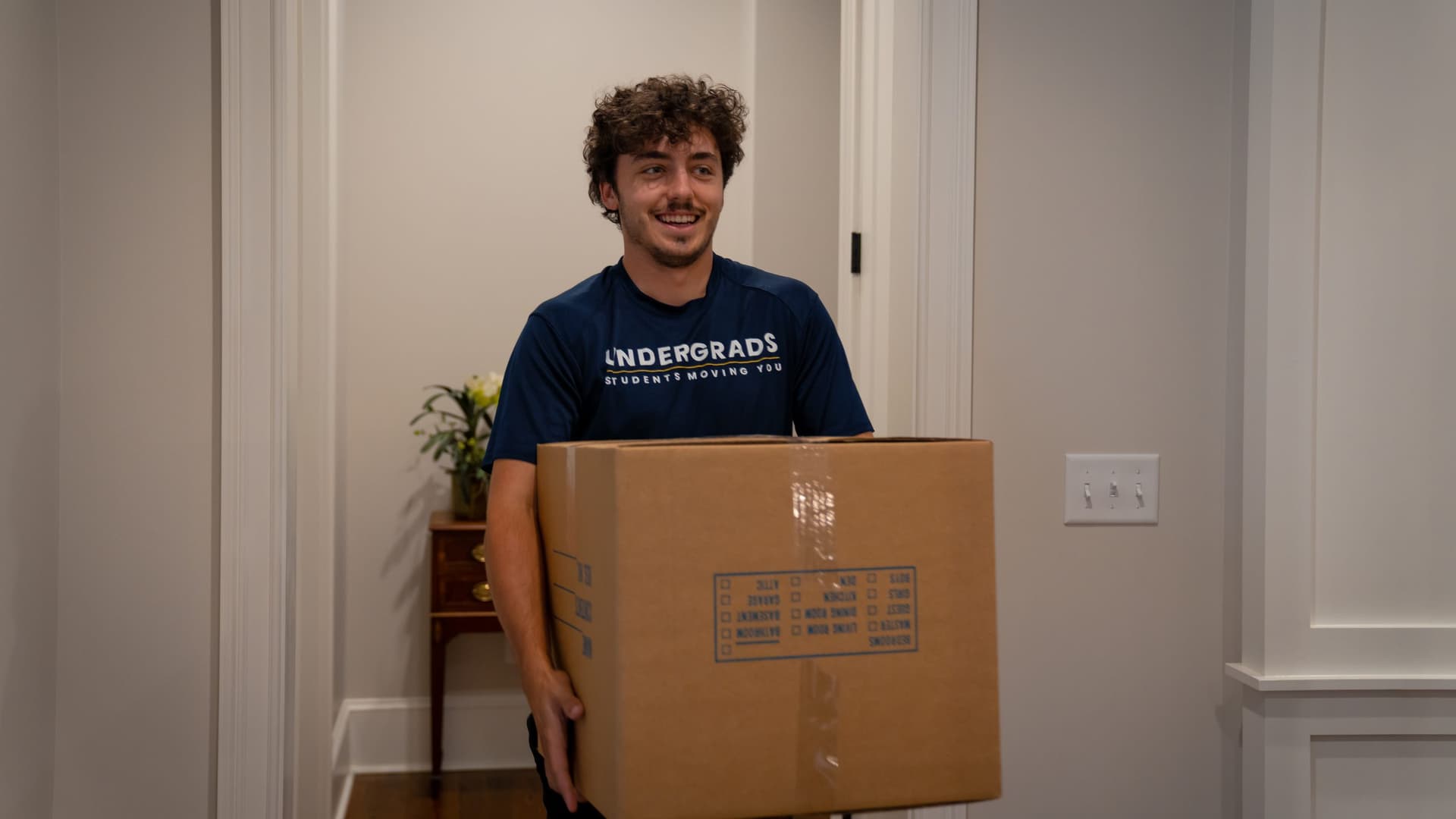
Here is the thing about labels: most people label once, on the front, in pencil. Boxes stack in trucks. The front label faces the wall. Your crew cannot read it without moving the box, which slows everything down.
The system that works: color-coded tape by room. Blue for bedroom, red for kitchen, green for bathroom, yellow for living room. One roll of colored tape per room costs $3 at any hardware store. Your crew can move without reading a single word. Box goes in, color gets matched to the room. Unloading time drops significantly.
Also: label the top of every box. When boxes are stacked 4 high in a truck, the only visible surface is the top. Write the room name and a one-line contents description on the top of every box with a thick Sharpie.
How to pack specific items that people always get wrong
Plates
Pack plates vertically, like records in a crate. Stacking them flat puts all the weight on the bottom plate. Vertical packing distributes weight across the edge, which is structurally stronger. Wrap each plate individually in packing paper first, then stand them in a small or medium box with crumpled paper filling the gaps.
Electronics
Spend 90 seconds photographing the back of your TV stand, cable box, and home theater setup before unplugging anything. You will need this when reconnecting at the new place. Original boxes are best for electronics, but if you do not have them, wrap screens in moving blankets and pack the device upright, never flat.
Mirrors and framed art
The safest way to move a mirror is in a mirror box, available at U-Haul for $8-15. If you do not have one, tape an X across the glass with masking tape (this holds shards together if it breaks), wrap the whole piece in blankets, and carry it flat with nothing on top.
Clothes on hangers
Group 10-15 hangers together, keep the clothes on the hangers, pull a garbage bag up from the bottom with the hangers poking through the tied end. You now have a portable wardrobe that goes straight onto a rod at the new place. This takes 2 minutes and protects your clothes better than a wardrobe box.
The open-first box: pack this last, unload it first
Every move needs an open-first box. This is the box you pack last and put in your personal vehicle, not the truck. It contains everything you need for the first 12 hours without digging through boxes.
- Coffee maker and pods or ground coffee
- One set of plates, glasses, and utensils per person
- Toilet paper (2 rolls minimum)
- Phone chargers for everyone
- One change of clothes per person
- Important documents: lease, IDs, insurance cards
- Medications
- Paper towels and a small cleaning spray
- Snacks for the move day
- A small toolkit: screwdriver, Allen wrench, box cutter
Frequently asked questions
How far in advance should I start packing?
For a 1-bedroom apartment, start 2 weeks out. Pack non-essentials first: books, decor, out-of-season clothes, and anything in storage. Leave daily-use items for the last 2-3 days. For a 2-bedroom, start 3 weeks out. Most people start too late and end up packing in a panic the night before.
How many boxes do I need for a 2-bedroom apartment?
A 2-bedroom apartment typically requires 40-60 boxes. That breaks down to roughly: 10-15 small boxes for heavy items, 15-20 medium boxes for most household goods, 10-15 large boxes for linens and light items, and 5-10 specialty boxes for dishes, mirrors, and wardrobe. Buy more than you think you need and return the unused ones.
Is it worth buying packing supplies or using what I have?
Use what you have for padding. Towels, t-shirts, linens, and socks all work as packing material for most items. Buy proper boxes, tape, and packing paper for structure and fragile item wrapping. Total supply cost for a 2BR move should be under $60 if you source free boxes.
Can I leave clothes in drawers during the move?
It depends on the dresser. Lightweight dressers can sometimes travel with clothes in the drawers if you secure the drawers with tape or stretch wrap. Heavy wood dressers should be emptied because a loaded drawer can crack the frame under its own weight in transit. Ask your crew before the move.
What should I pack last?
Pack in this order, leaving these for last: bedding (pack the morning of the move), toiletries (pack after your last morning routine), cleaning supplies (save a few items to clean after everything is out), your open-first box contents, and any items your crew will need access to for disassembly.
Ready to book your crew?
Background-checked movers, locked hourly rate, no stair fees or fuel surcharges. Studio and 1BR moves typically run $200-$499, 2-3BR homes $450-$700. Show-Up Guarantee: $50 back if we are late. $5 holds your date. Pay after the move. See our reviews from 500+ happy customers.
Get my free quote →