

Houston is a phenomenal city to live in. It’s also a genuinely difficult city to move in. Between weather that can’t decide if it wants to melt you or drown you, a highway system that looks like someone dropped a plate of spaghetti on a map, and a city so sprawling that your move might technically qualify as interstate travel, there’s a reason people dread moving day here.
Let’s walk through what makes moving in Houston uniquely challenging, and how to actually deal with it.
The Heat and Humidity Are Not a Joke
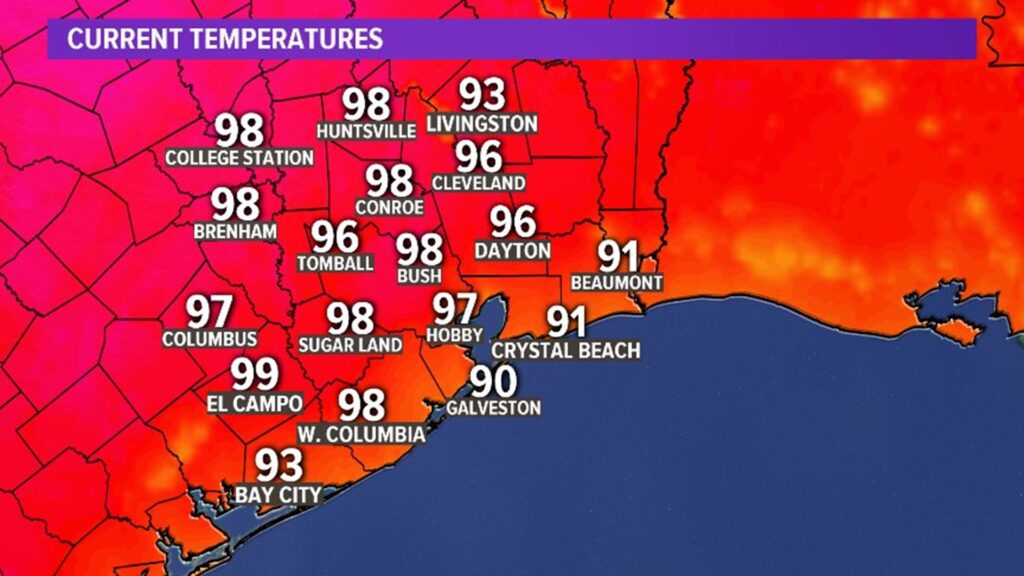
Let’s start with the most physically punishing one: Houston summers are brutal in a way that’s different from other hot cities. Phoenix is hotter, but it’s dry. Houston combines 95–100°F temperatures with 80–90% humidity, which means the heat index—what it actually feels like on your skin—regularly pushes 110°F+. You’re not just hot. You’re wet and hot. You’re a human swamp.
Houston averages about 100 days per year above 90°F and has logged multiple triple-digit days every summer since anyone started counting. The record high is 109°F (2000), and heat advisories are so common from June through September that the National Weather Service practically has a template.
When you’re hauling a couch up a third-floor walkway in that kind of air, heat exhaustion isn’t a hypothetical. It’s the most underrated moving hazard in this city, and the one most people wave off until they’re sitting on the curb looking pale and wondering why their vision is blurry.
What to actually do about it:
- Schedule your move early. Start at 7 or 8 AM before the heat peaks. By noon in summer, you want to be done or at least inside. The humidity is actually worse in the morning (sometimes 95%+), but the temperature is more manageable.
- Drink water constantly—not just when you’re thirsty. By the time you’re thirsty, you’re already dehydrated. Gatorade or electrolyte packets are not optional. Your muscles will cramp without salt replacement.
- Avoid June through September if possible. October through April is Houston’s sweet spot—the heat breaks, the humidity drops to merely uncomfortable, and you’ll actually enjoy move-in day.
- Keep the truck in the shade when possible and don’t leave items inside longer than necessary. A cargo hold in direct Houston sun can hit 140°F+. Your candles will become abstract art. Your vinyl records will become bowls.
- Wear moisture-wicking clothes, not cotton. Cotton absorbs sweat and turns into a wet blanket. This sounds like minor advice until you’re carrying a dresser up stairs in a soaked t-shirt.
Our crews at Undergrads are conditioned to the heat, but even we hydrate aggressively, take breaks, and schedule our Houston movers with the weather in mind. If a moving company tells you heat isn’t a factor, find a different moving company.
Flooding: Houston’s Actual Worst-Case Scenario
Every city has weather challenges. Houston’s is flooding, and it’s not an occasional inconvenience—it’s a defining feature of living here.
Houston sits on flat, clay-heavy soil with essentially zero natural drainage, in a subtropical climate that dumps an average of 50 inches of rain per year. The city has experienced five 500-year flood events since 2015. Let that sink in: five supposedly once-in-500-years events in about ten years. Hurricane Harvey in 2017 dropped over 60 inches of rain in some areas, damaged or destroyed 200,000+ homes, and caused $125 billion in damage. Tropical Storm Imelda (2019) and multiple unnamed storms have flooded neighborhoods that “never flood” since then.
What does this mean for moving day? It means you need to check the forecast, and not just for the day you’re moving—check the week before. If there’s been significant rain, streets may still be flooded, bayous may be at capacity, and one more downpour can turn a neighborhood into a lake. Houston doesn’t flood evenly; some streets are impassable while the next block is dry.
What to actually do about it:
- Check the Harris County Flood Warning System (harriscountyfws.org) before and during your move. It shows real-time bayou levels and road closures.
- Avoid moving during hurricane season peaks (August–October) if you can. This isn’t always possible, but if you have flexibility, use it.
- Never drive through standing water. “Turn Around, Don’t Drown” isn’t just a slogan—it’s the number one cause of flood deaths. Six inches of water can stall a car. Two feet will float a moving truck.
- If you’re moving into a ground-floor apartment or a house in a flood-prone area, elevate your belongings during unloading. Don’t put boxes directly on the garage floor. Use pallets or shelving.
- Ask your new landlord or neighbors about flooding history. FEMA maps are helpful but outdated—local knowledge is better. If three neighbors say “this street floods,” believe them.
We’ve moved people during every type of Houston weather, and we’ve also rescheduled moves when conditions were unsafe. There’s no furniture worth risking your safety—or your movers’ safety—for.
Houston Traffic and the Sprawl Factor
Houston is the fourth-largest city in America, but it’s built like a city that expected to be the first. The metro area covers over 10,000 square miles—roughly the size of Massachusetts—and is connected by a highway system that includes I-10, I-45, I-69/US-59, the Sam Houston Tollway (Beltway 8), Loop 610, and the Hardy Toll Road. That’s a lot of highways, and they’re all congested.
Houston consistently ranks among the worst cities in the country for traffic. The average Houston commuter spends about 75–80 hours per year stuck in traffic, and if your move involves crossing from one side of the metro to another—say, Katy to Clear Lake—you’re looking at a 60–90 minute drive each way. In a 26-foot moving truck. With your entire kitchen strapped in the back.
The corridors that will ruin your day:
- I-10 (Katy Freeway) — The widest freeway in the world at 26 lanes. Still congested. More lanes have not solved the problem, and they never will. The Katy-to-downtown stretch during rush hour is a parking lot.
- I-45 (Gulf Freeway / North Freeway) — Runs from Galveston through downtown to The Woodlands. Construction has been ongoing since Texas was a republic and will continue until the heat death of the universe.
- US-59/I-69 (Southwest Freeway) — Connects Sugar Land and the Galleria area to downtown. Notorious for accidents and slowdowns even outside rush hour.
- Loop 610 — The inner loop that circles central Houston. Great in theory. Perpetually jammed in practice, especially near the Galleria.
- Beltway 8 (Sam Houston Tollway) — The outer loop. It’s a toll road, so it moves faster, but you’re paying $2–$4 per segment for the privilege.
What to actually do about it:
- Move on a weekday, not a weekend. Counterintuitive, but weekends in Houston bring brunch traffic, church traffic, and suburban shopping traffic. Tuesday and Wednesday mornings are your best bet.
- Avoid rush hour at all costs. Houston rush hour runs roughly 6:30–9:30 AM and 3:30–7 PM, and it’s not a polite slowdown—it’s a standstill. Start at 7 AM and try to finish by 3 PM.
- Factor in toll costs. If your move route uses the Hardy Toll Road, Beltway 8, or Westpark Tollway, you’re looking at $5–$15 in tolls per trip. In a moving truck making multiple trips, that adds up.
- Use Google Maps or Waze in real time. Houston’s traffic is unpredictable—a fender bender on 610 can back up traffic for 45 minutes. Don’t assume your usual route will work.
- If you’re moving cross-metro (Katy to Pearland, The Woodlands to Sugar Land), consider whether it makes sense to hire movers rather than making multiple trips yourself. Time is money, and gas at $3.20/gallon adds up across 80 miles of driving.
The Parking Situation (Worse Than You Think)
Houston doesn’t have the same parking crisis as cities like New York or San Francisco, but that doesn’t mean moving-day parking is simple. In popular neighborhoods like Montrose, the Heights, Midtown, and EaDo, street parking is competitive, apartment complexes are dense, and loading zones are either nonexistent or already taken.
Many newer apartment complexes have parking garages with clearance heights too low for a moving truck. Older complexes have parking lots designed for compact cars in the 1970s, not 16-foot box trucks in 2026. And if your new place is a townhome in the Heights or Rice Military, you might be looking at a one-lane street with cars parked on both sides and zero room to maneuver.
What to actually do about it:
- Call your apartment or building management before move-in day. Many complexes have loading docks or reserved spots that require advance scheduling. Some will give you a temporary parking pass for a moving truck. Some won’t tell you any of this unless you ask.
- For townhome moves in dense neighborhoods, consider using a smaller truck or van and making multiple trips. Getting a 26-footer down a narrow Heights side street is a special kind of hell.
- Know the parking rules for your specific street. Some neighborhoods have permit parking, time-limited meters, or no-parking zones during certain hours. Getting a ticket on moving day is the cherry on top nobody wants.
- If you’re moving downtown, budget for paid parking. Meter rates, garage fees, and the stress of circling the block in a loaded truck all add up. Consider whether paying for a reserved loading spot is worth the sanity.
The Houston-Specific Surprises Nobody Mentions
A few Houston-specific moving challenges that don’t get enough airtime:
The bugs.
Houston is home to cockroaches the size of your thumb (locals call them “tree roaches” or “waterbugs” to feel better about it). If your moving boxes have been in a garage or storage unit, expect visitors. Mosquitoes are also aggressive year-round. Move during the day, keep doors closed when loading/unloading, and spray down any boxes that have been stored outside.
The mold.
Houston’s humidity means mold can develop on belongings stored in non-climate-controlled spaces. If your stuff has been in a storage unit without AC, check everything before you unpack. Mold on furniture, clothes, and books is more common here than people expect.
The distances.
People underestimate how far apart things are in Houston. Your new apartment in Katy and the IKEA in the Galleria area are technically in the same metro, but that’s a 45-minute drive. Plan your day around geography, not optimism.
The Bottom Line
Moving in Houston comes with four predictable headaches: heat and humidity that can genuinely make you sick, flooding that requires real planning and respect, traffic that’s measurably among the worst in the country, and a city so spread out that your move might feel like a road trip.
None of these are insurmountable—they just require not winging it. Start early, check the weather (and the flood maps), plan your route before the truck is loaded, and for the love of everything, hydrate.
And if you’d rather hand the logistics to people who do this every day, Undergrads has you covered—no hidden fees, no corporate nonsense, just UH students who know this city and show up when they say they will.